Emily Casella
Artist Reception | Friday, September 18th 5-8pm
Artist statement
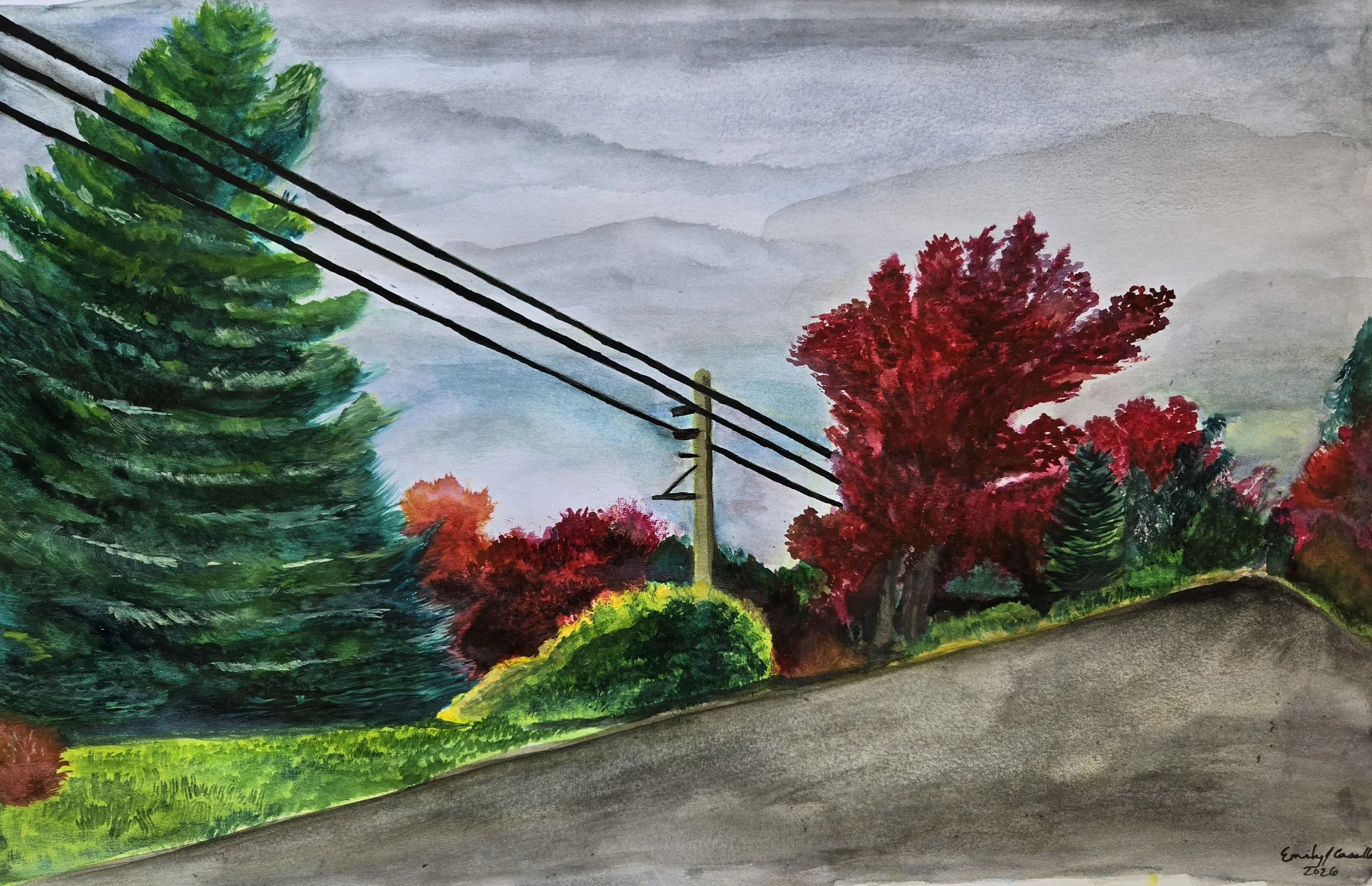
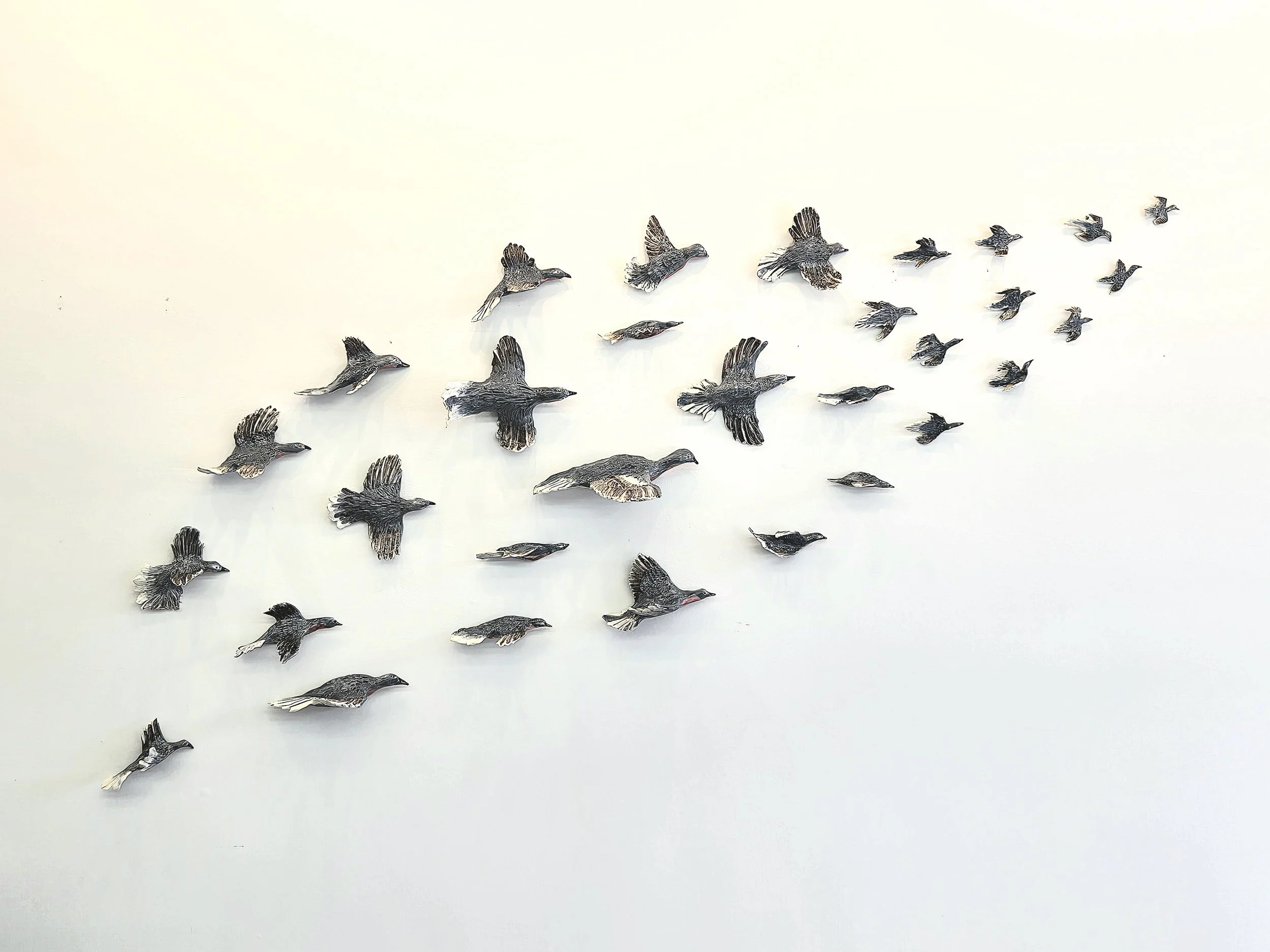
Watch Out Humans Coming Through: The Plight of the Passenger Pigeon Expanded, is a multi-media art installation by Emily J Casella. This installation consists of two parts, one for each wall space in Ancillaerie: the 12 watercolor landscapes of trees’ relationship to telephone/power lines and the sculptural works presenting the extinction of the birds of the Columbidae family, commonly known as pigeons and doves. They combine to create a conversation of the past and present.
Like many humans, I learned about the most famous extinction of the Dodo at a very young age. This deeply disturbed and affected my idea about the man’s insatiable desire for food, relationship to the environment, and the power to be destructive.
Decades later, I was introduced to the Passenger Pigeon by Kristina Knowski, the owner of Ancillaerie. The Passenger Pigeon was once North America’s largest bird population estimated at 3-5 billion birds found around the Great Lakes region of North America. The people started mass deforestation during 1870-1890s. On the east coast, people would sell them for as cheap as five cents for a dozen. The people did not understand that the Passenger Pigeons only laid 1 egg a year and bred in a 1.2 square kilometer region south of the great lakes. They could not reproduce quickly enough. The birds started to eat the crops, which caused the humans to kill them for being pests, even though they were natural seed dispersers for the forests. There is a story of a farming couple who threw potatoes at them to knock them down. The people incessantly killed them. The last Passenger Pigeon that was living in the wild was shot in Laurel, Indiana in 1902. Due to the rapid decline, they were put into zoos to try to keep the species alive. Martha, the last Passenger Pigeon, died at the age of 29 in the Cincinnati zoo September 1, 1912.
While researching the Dodo and the Passenger Pigeon, I realized that there are so many more extinct birds. I chose the Columbidea family because I have done previous work about pigeons. In the Family Tree Memorial artwork, there are 19 other species that became extinct because mainly European explorers hopped through islands, bringing rats, deforestation, and their stomachs. All in the spirit of exploration! Most of these birds were discovered and extinct before cameras. We only have descriptions from explorers and drawn artworks.
The watercolors of Trees and Telephone/Power Lines came from my own hopping. Driving to different jobs, I would notice trees and their relationship to human made lines. It is odd that live trees have to adjust to the lines that are on dead wood posts. When I was younger, I noticed birds clustered on the lines, which I thought was cute. In truth these lines are dangerous and if birds do not sit on them just right, they will be electrocuted. Although there are no humans present with the lines, we continuously have this relationship of disrupting the space and environment. I’m interested in the relationship created between the lines navigating through the shape the trees have to create, reminding me of human interactions.
It is just happenstance that this region had such a destructive storm early in August. The emergency caused a lot of people besides myself to take notice to trees’ relationship to power lines. The smell of the fallen trees permeated the air in August and September, only to be replaced with dead leaves in the Autumn. I mourn the trees that have fallen for our insatiable need for power and the birds we never got to meet.
We once had so many birds that made clouds in the sky, but now all I see are telephone lines.
Emily J Casella
Artist Bio:
Emily J Casella is a multimedia installation artist from Northwest Indiana. When she is not making ceramic figures, pigeons, or thinking about trees, she is teaching at colleges and universities in Indiana and Illinois. She has a MFA in Ceramics from Herron School of Art and Design in 2019 and a BFA from Indiana University Northwest 2016. Her ceramic figures have traveled around to be displayed in public buildings and galleries. Her large and small scale paper works have been in numerous shows nationally and owned in private collections. To follow along with her art adventures, you can go to emilyjcasella.com and join her newsletter.